Driving while old is like wearing sunglasses at night, and it is going to get worse
The demographic time bomb, combined with brighter, bluer LEDs on light trucks, will make things much more dangerous for everyone on the road.

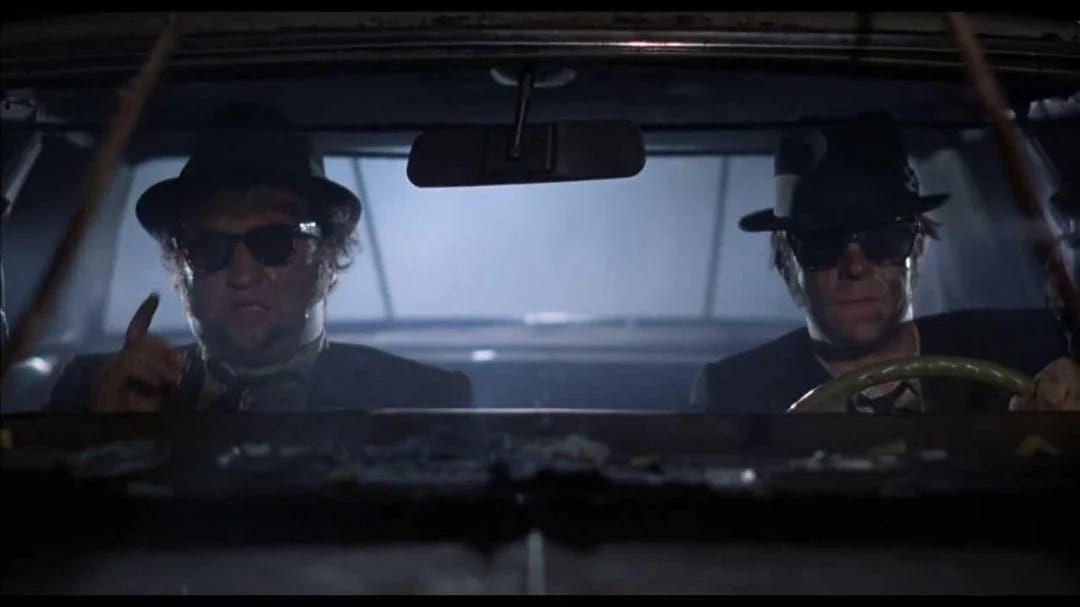
"It's 106 miles to Chicago, we got a full tank of gas, half a pack of cigarettes, it's dark out, and we're wearing sunglasses."
Driver Dan Ackroyd is now 73, and if he were driving today, he would feel right at home; according to one report, “the retina of an 80-year-old receives far less light than the retina of a 20-year-old, making older drivers function as though they are wearing sunglasses at night.”
I am four months younger than Ackroyd, and I no longer drive at night- I was no longer confident about my night vision, but it also seemed that the lights in oncoming cars and light trucks seemed much brighter and higher, shining right into my eyes. I thought it must be me, rather than the headlights, because I assumed they were regulated. It turns out to be a bit of both.
Andrew Miller of Changing Lanes notes that Transport Canada is looking into the issue of vehicle headlights and glare at night. He wrote an excellent post about the issue last year and summarized it in a submission to the Motor Vehicle Safety Division:
Headlight glare has worsened materially as LED technology has spread, increasing output from roughly 600–700 lumens in the sealed-beam era to 3,600–4,500 lumens today, at a colour temperature the human eye finds more discomforting;
The resulting glare is not merely an annoyance but a probable contributor to the documented rise in nighttime pedestrian fatalities, and
The most effective regulatory response is to mandate auto-levelling and headlamp-cleaning systems—as the European Commission has required since 1990—while tracking adaptive driving beam (ADB) technology for future mandating as costs fall.
In his article, Blinded by the Light, Miller explains that the brighter bluer lights are great for drivers, who can see further and more clearly, but harder for everyone else (Very much like SUVs and light trucks are safer for drivers and disproportionately kill everyone outside). Similarly,
“Those not in their own cars face even greater challenges. Cyclists and pedestrians lack the partial protection of a windshield and often have their eyes fully dark-adapted when vehicle headlights approach. Consequently, the blinding effect can be total, and take longer to recover from. For a pedestrian attempting to cross a road or a cyclist navigating a narrow shoulder, temporary blindness can be life-threatening.”
Miller covers the technical issues of the vehicle headlights thoroughly in his post, but my concern here is the demographic time bomb, the aging population, who have aging eyes.

This is not a problem just for the leading edge of the baby boomers who are turning 80 and who I wrote about previously; the youngest boomers are 62, and their eyes are changing, too. Here’s what happens:
The lens yellows and thickens. Starting in your 40s and accellerating after 60, “Aging is associated with yellowing of the lens and reduced transmission of short-wavelength light. This arises from age-dependent accumulation of pigments in the crystalline lens that preferentially absorb blue light”1. This scatters incoming light, turning bright point sources like headlights into halos and starbursts.
The pupil shrinks, and recovery takes longer. “The smaller opening of the pupil with age, a condition known as senile miosis, markedly limits the amount of light falling on the retina. The disorder may be most serious in dim light, because the aging pupil's maximum diameter may only be one-fourth that of a younger eye.” 2
There are fewer rod cells to read the light after it gets through those shrinking yellowing lenses. Rods are sensitive to low (mesopic or twilight) levels of light. “For example, the number of light-sensing cones in the most sensitive area of the retina (the fovea) may decrease dramatically between age 40 and age 60. This is believed to affect the clarity of eyesight.”
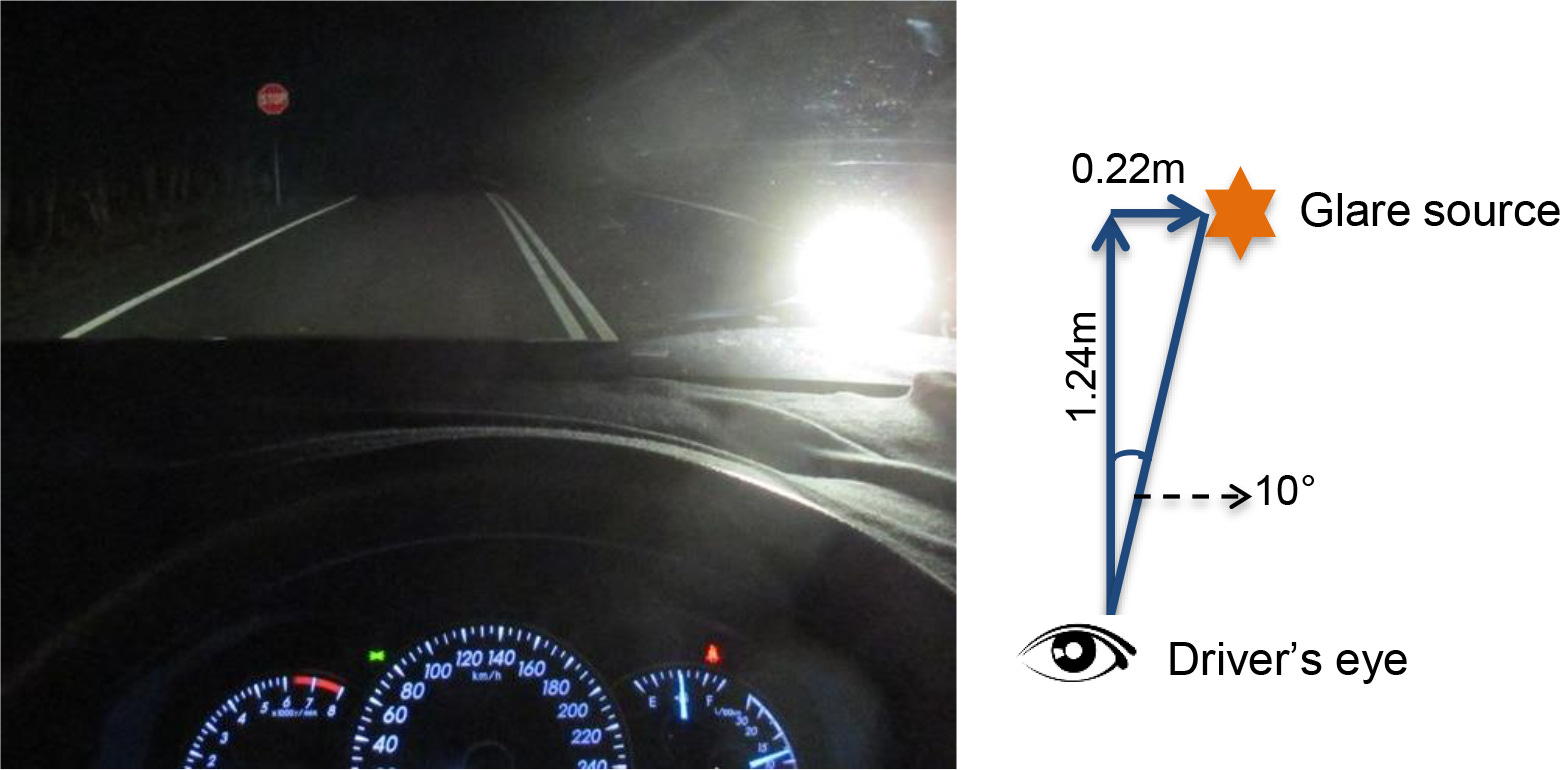
Glare sensitivity compounds everything. This is the biggest deal with the brighter, bluer, higher LED headlights. “Visual function decreases at an earlier age and to a greater extent for low contrast targets and mesopic conditions compared to high contrast targets and photopic conditions.”3
Lower sensitivity to mesopic (low-level) light combined with “increased intraocular scatter from age-related lens and ocular media changes” creates a cascade of glare effects. Conventional eye tests don’t capture this.
“In the absence of evidence-based advice from their eye care professionals, these patients are likely to self-select whether or not to drive at night. This is problematic, given that drivers are known to underestimate their visual limitations at night, have limited insight into their own driving abilities, and regulate their driving based more on confidence than actual driving ability.”
So in summary:
Sensitivity to glare increases with age as lenses lose transparency and light scatters more inside the eye. The pupils cannot respond quickly enough, taking as much as four times as long as younger eyes. The blue shift creates even more glare because shorter wavelengths scatter more. And to top it off, many older drivers are overconfident or have no choice or alternatives to driving.
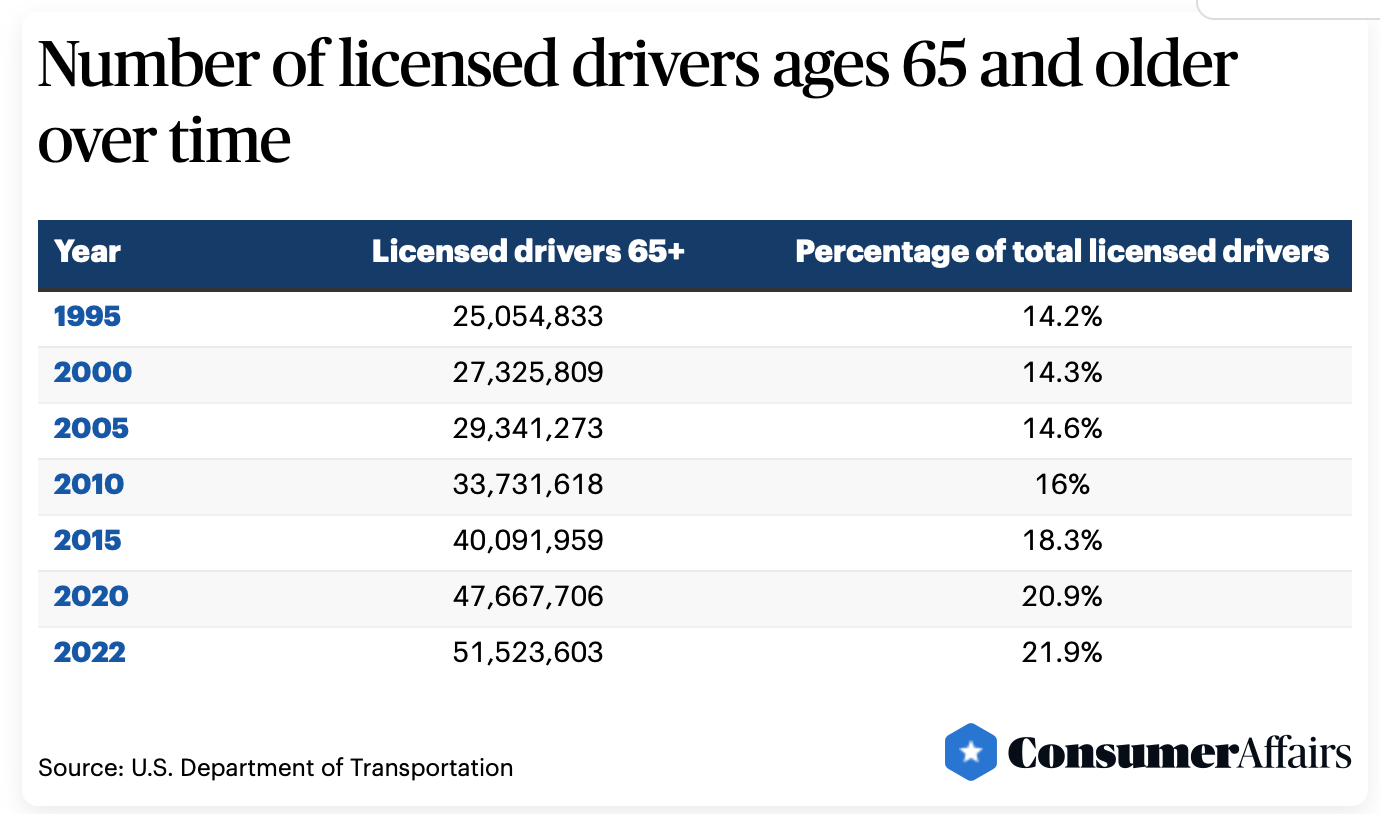
Meanwhile, the number and proportion of older drivers is increasing dramatically. According to Consumer Affairs, “According to 2022 data from the U.S. Department of Transportation, more than 51 million licensed drivers were 65 or older that year. This represents 21.8% of all licensed drivers in the country.”
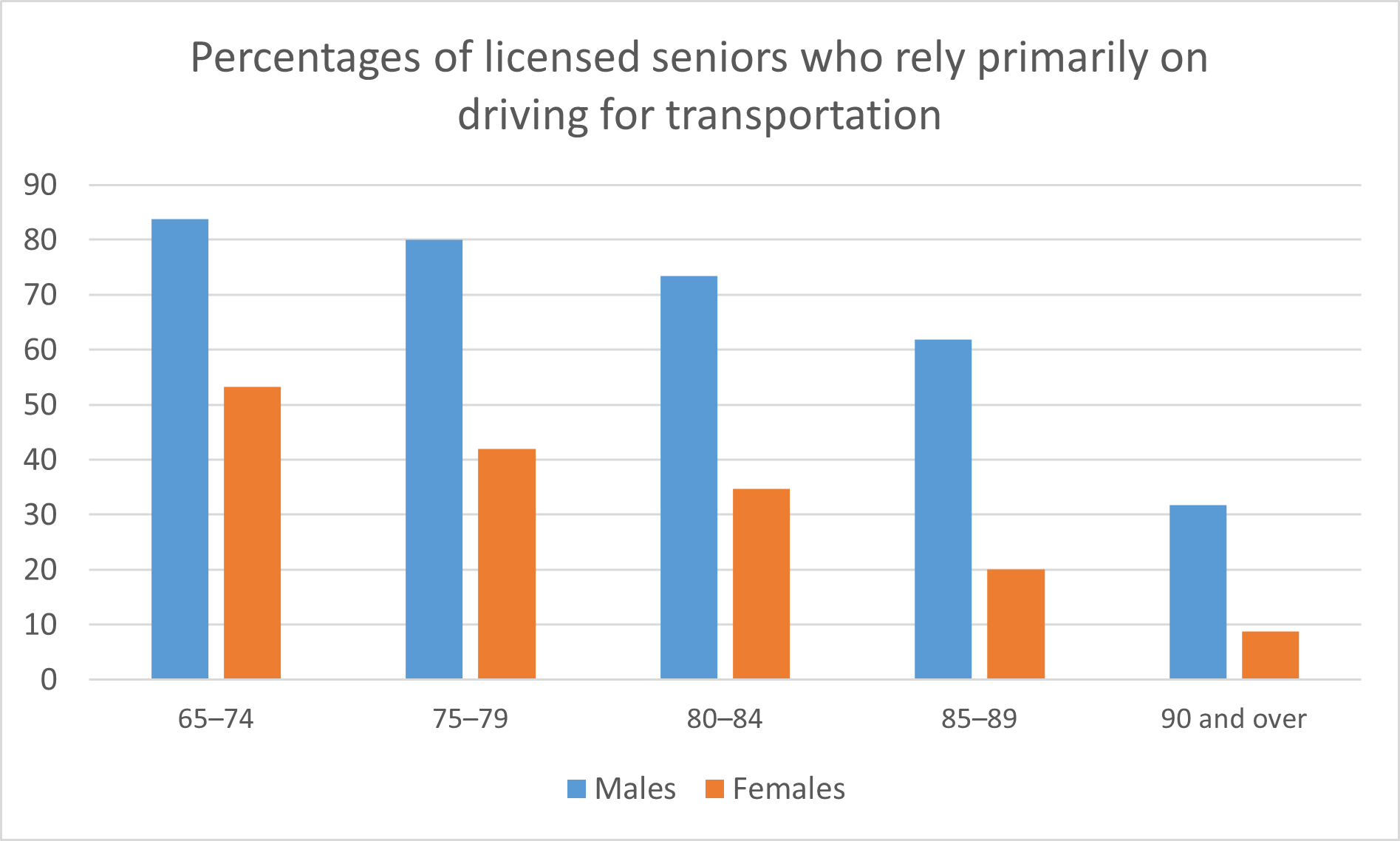
In Canada, drivers over 65 years old are now the largest group of licensees- 5.27 million of them. “A survey of Canadian drivers in March 2017 found that 26% of drivers aged 65 and older wanted to keep their licences past age 85.”4
So what we have here are two colliding trends: Older adults with increased sensitivity to glare from bright blue LED headlights are a growing share of all drivers, while headlights keep getting brighter, bluer, and higher.
I always quote David Foot, who wrote that “demographics can explain two-thirds of everything.” Andrew Miller’s call to regulate headlights as they do in Europe becomes even more critical when you consider the changing demographics of the driving population.
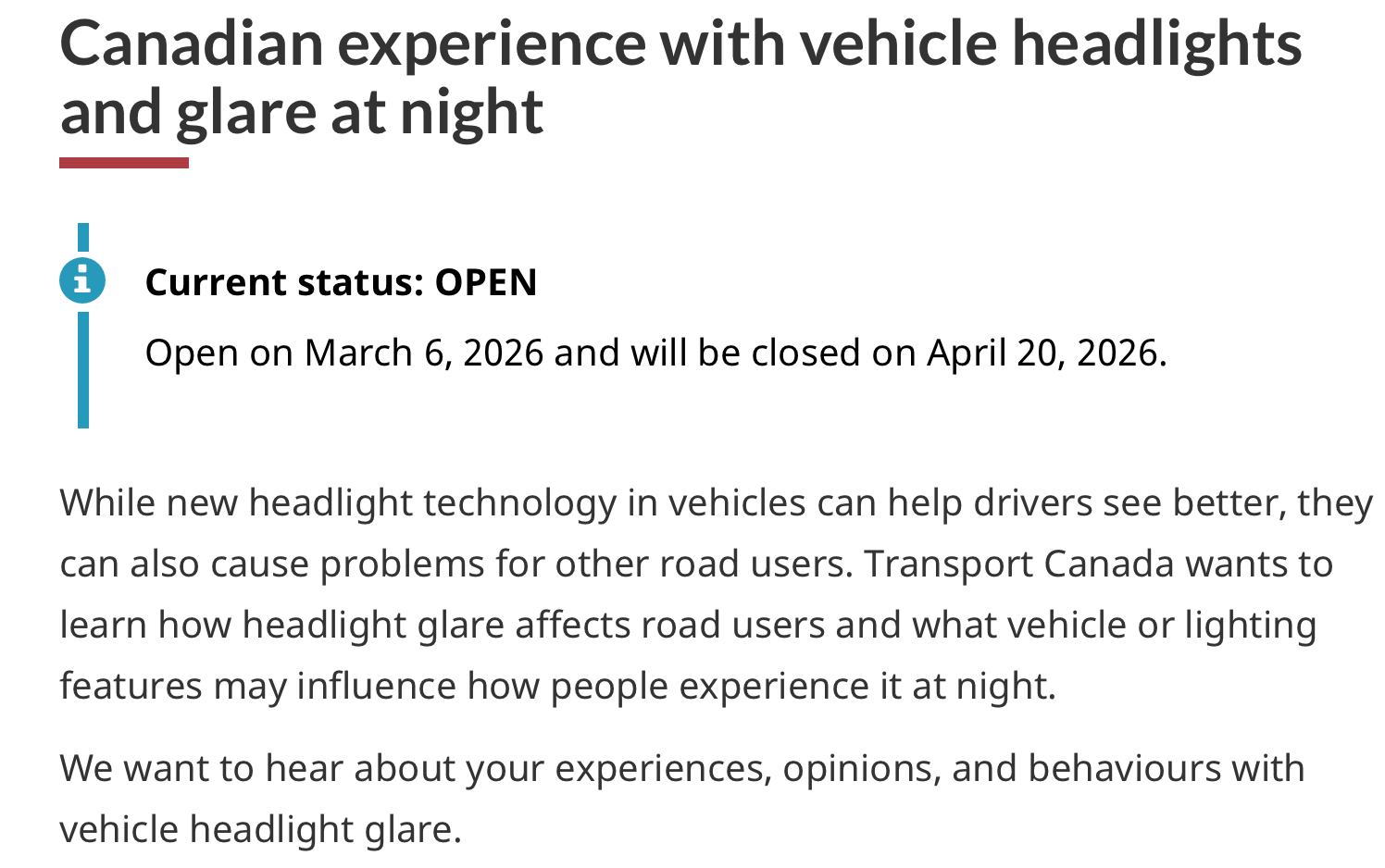
Canadian readers can tell Transport Canada what they think about headlights and glare in a survey, although my experience is that they don’t listen if it involves doing things differently than the regulators in the USA.
The Ultimate List of Canada Driving Statistics for 2025 (Source: https://tests.ca/driving-statistics/)
The same demographic that fight tooth and nail against neighbourhood densification efforts will eventually be stranded in their unwalkable community with density too low to make transit useful.
Fun times ahead.
On top of doing Transport Canada survey, I signed this petition to the commons https://www.ourcommons.ca/petitions/en/Petition/Details?Petition=e-7159
It calls upon the Government of Canada to:
2. Incorporate criteria into these regulations that consider human perception of brightness;
3. More strictly regulate the colour spectrum, power and dispersion of light beams, particularly those using LED technology; and
4. Take concrete measures to reduce glare and improve road safety for the entire population, especially seniors.