Why your retirement plans should include Passivhaus
Older people in particular have to plan for thermal as well as financial security.


I often write about the long-term crisis of climate change, but a recent article by Dr. Joseph Coughlin of the MIT Aging Lab discusses what he calls “temporary” crises. Except when you are an older baby boomer like me, temporary can feel like a very long time.
In his article in Forbes, Why ‘Temporary’ Is The Most Expensive Word In Retirement Planning, Coughlin notes that when planning for retirement, people assume that they can model for inflation and expected longevity. What they don’t plan for is what the British Prime Minister Harold Macmillan answered when asked about the biggest problem he faced: “Events, dear boy, events.”
Coughlin lists events of just the last five years that were “temporary”: The pandemic. supply chain collapse. Inflation surge. Ukraine war. Now, the US-Israel-Iran conflict. All of them rattle the markets, increase costs, and disrupt planning. “They are eroding decades-old assumptions about what it means to be prepared for retirement.”
He points to energy costs. “Energy is not merely a utility. It is embedded in nearly everything: heating, cooling, transportation, food production, the delivery services that older adults increasingly depend upon, the cost structure of care itself.” He then points to fertilizer and the cost of food. The key point is that we have to be prepared for shocks- “the systems that underpin daily life — energy, supply chains, and healthcare — are more exposed to disruption than the standard retirement playbook assumed.”

“Structural preparedness means examining the physical infrastructure of your retirement, not just the financial one. How dependent are you on a car in a world where driving may become difficult or costly? How exposed is your home to volatile energy costs, and how hard would it be to reduce that exposure? How far are you from the healthcare you will eventually need, not the healthcare you need today? These are not amenity questions. They are resilience questions — and they belong in the retirement planning conversation alongside withdrawal rates and asset allocation.”
Coughlin never mentions climate change, even though it drives many of the problems he lists, but then he is writing in Forbes. An earlier article in Earth911 by financial planner Chris Orestis raised many of the same issues, pointing to climate change as the cause of many of these “temporary” problems:
“Planning for retirement becomes more complex as the impacts of climate change transform our environment. The rise of heatwaves, wildfires, drought, hurricanes, and flooding are all recipes for disaster in the lives of seniors who are not well-suited to cope with these conditions.”
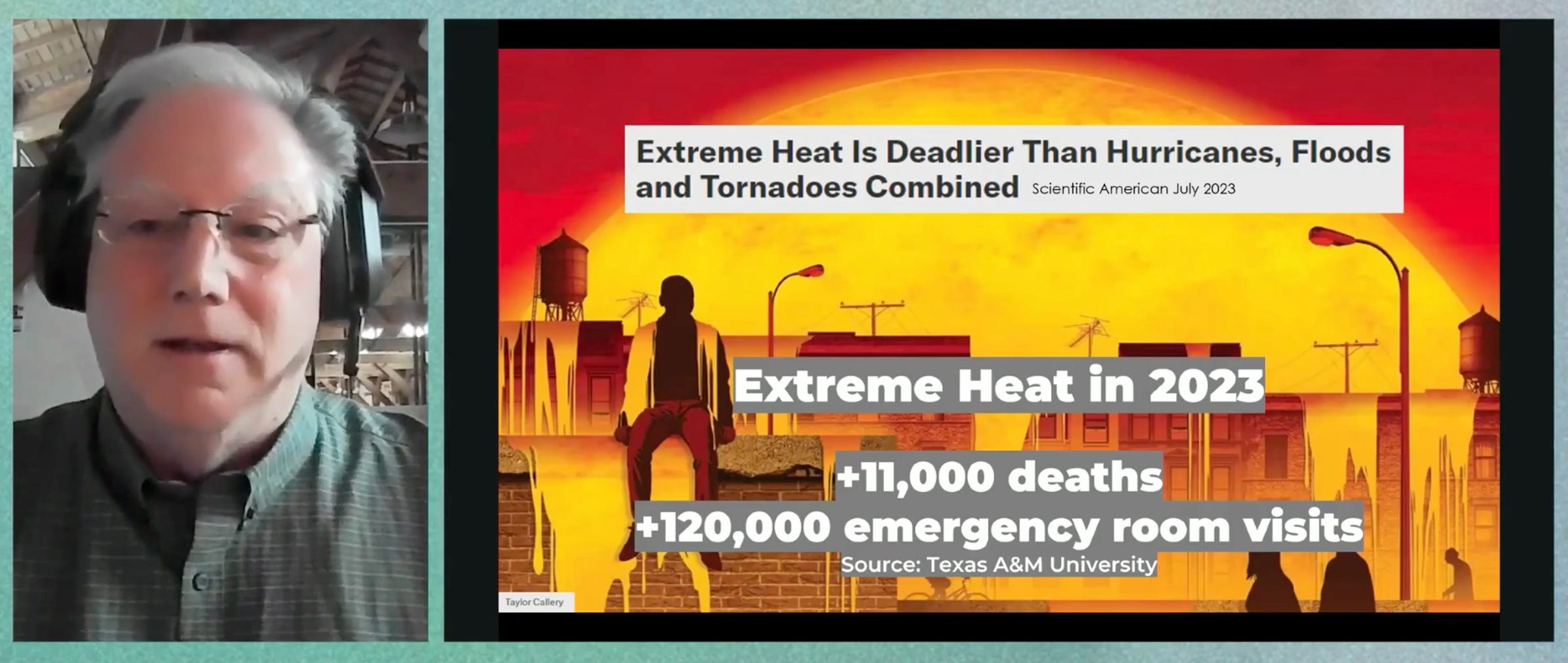
I am part of a group in the Reimagine Buildings Collective that has been looking at “passive survivability.” It’s defined as “the ability to maintain safe thermal conditions during an extended power outage or loss of critical services.” Heat will likely be the biggest problem; we haven’t been designing for it. For all those baby boomers who want to age in place and stay in their homes, the form and the windows may be all wrong, and they may overheat quickly if the power goes out, or may be too expensive to cool if energy costs continue to climb.
Coughlin asks if we are ready for this. “Are you prepared not just financially but structurally for a world that has become more uncertain than the plan assumed?” The answer for most people is no. Their houses cannot protect them from extreme heat or cold or smoke if the power goes out or is too expensive. They don’t live in walkable communities where they can get food and supplies without driving.
However, there are many things that can make it easier to prepare financially and structurally:
It helps to live in a dwelling designed to the Passivhaus standard. They cost a bit more to build, but once you are in it, you are resistant to both thermal and price shocks. This should be the minimum standard for new construction.
If you want to stay in your home, think of the changes you can make to deal with those “temporary” conditions. Insulate and seal where you can to reduce heat loss. Add exterior window coverings to reduce heat gain. Consider solar and battery backup. Think about multigenerational living; we subdivided our house into two apartments and rent the big one to our daughter’s family- the income covers the operating costs of the house, and we help take care of them now. Later, they will probably take care of us. It is the best move I have ever made.
Your diet is going to be affected by rising fuel costs, but it doesn’t have to be made of fossil fuels if you try to eat locally and seasonally. I wrote previously: Stop eating fossil fuels and tune in to turnip. My wife, Kelly, preserves enough tomatoes every summer that we could survive for months if we also stored some spaghetti.
Get a bike or an e-bike. Journalist Dana Blakenhorn recently wrote about how his e-bike changes the way he lives without burning a lot of gasoline: “This is the real E-Transport Revolution. Short rides, from your home, to shopping, to school, to the doctor.” This is obviously easier if you live in a walkable or cyclable neighbourhood, as both Blakenhorn and I do. But even in the suburbs, e-bikes can eat up the miles.

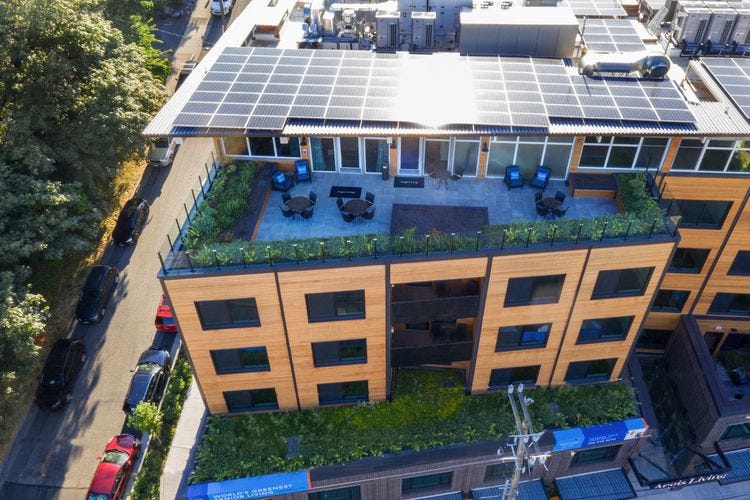
In multiple-unit housing designed for older people, the same rules apply. A few years ago, in Treehugger, I discussed the Aegis Living Lake Union assisted living community in Seattle, designed to the tough Living Building Challenge standard and which meets "105% of the building’s total energy demand through various energy reduction measures, including an onsite solar array and offsite solar energy farms that generate 1.7-million-kilowatt hours." I concluded:
“There are many people aging into this climate crisis, and they are among the most vulnerable. Aegis Living is doing some smart planning and marketing here—not only providing the usual services but doing it in a building that is healthy, doesn't run on fossil fuels, and doesn't need much fresh water–it is inherently resilient. It will also be cooler in heat waves and deliver fresher air when the forests burn.”
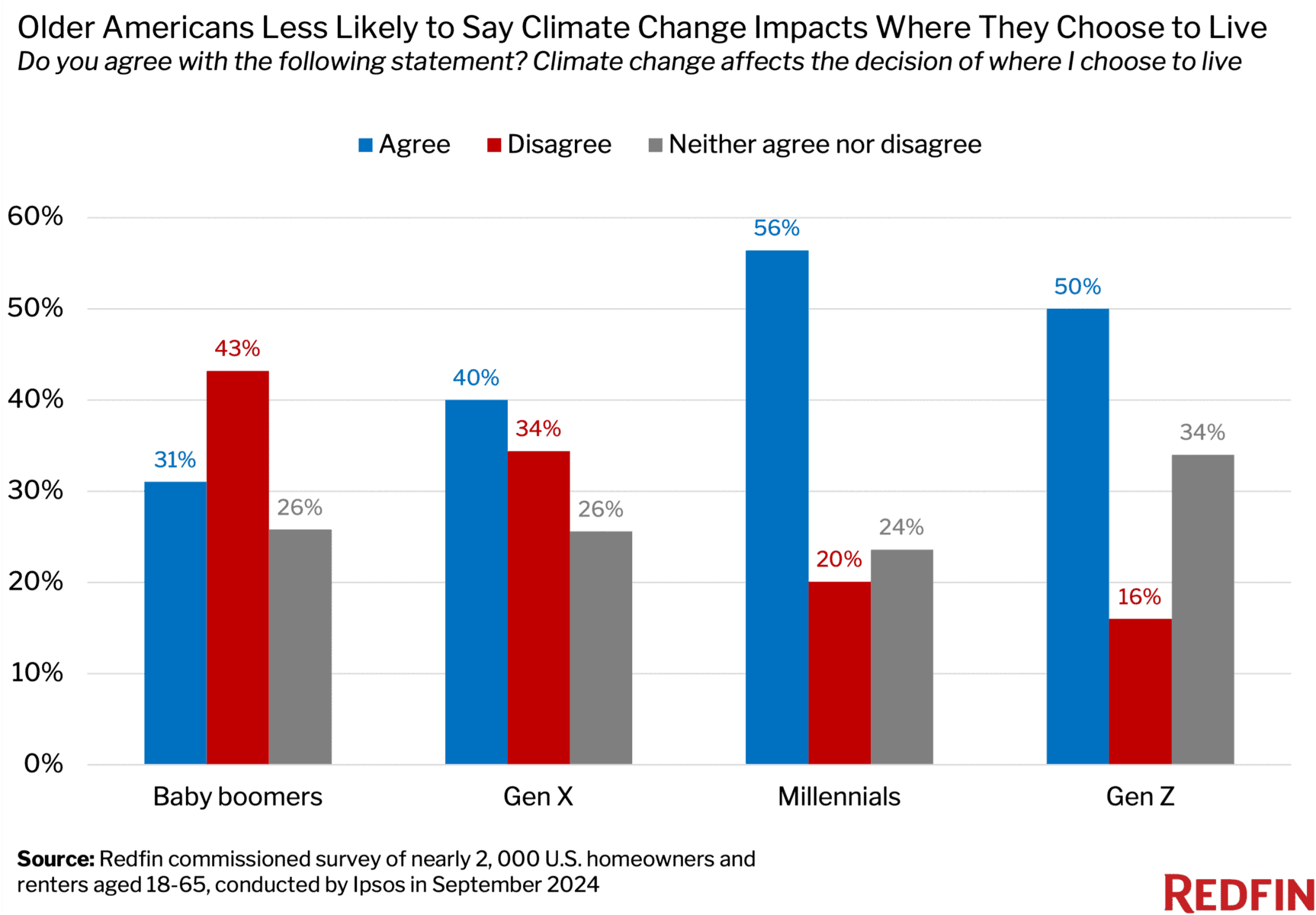
I don’t believe that many people are thinking about these issues. According to a study by Redfin, older people are less concerned about climate change than any other demographic cohort. More of them are moving to Florida than any other state, with agent Rafael Coralles noting that they don’t worry about these problems, long term or short. “When I explain to buyers that they can get more bang for their buck and lower flood risk a little further inland, they often tell me, ‘Rafael, we came to Florida for the waterfront views.’”
Again, Coughlin doesn’t mention climate change; he is talking about “temporary” problems. But after the current crisis ends, another will pop up. Some are political, but many are related to climate, and they are just going to get worse, and we aging baby boomers have to prepare for this- There are a lot of us and we are going to be around for a while.

It doesn't have to be Passive House to be affordable and thermally stable. Our DER 13 years ago is probably double PH in kWh/m2 for heat. In 2025 our total energy use was 6,090 kWh, 1,918 kWh of which is my wife's Bolt EV. The 4.76 kW PV system made 5,645 kWh, which covers 93% of the total load.
I'm 72 and my wife is 66, and we've thought about getting older where we live. We're 3 miles from where we buy most of our food, so not really walkable. Most of what we need is within a 5 mile radius, and I'm still able to ride a bike for most errands so my gas-powered car gets little use beyond trips. I have an older cargo bike (Surly Big Dummy) which I imagine at some point will get an electric assist.
We're in the early stages of moving a tiny (320 sf w/loft) house that was slated for demolition onto our lot as an ADU. It needs a lot of work which I hope to chip away at over a year or so. The idea is to help a tad with Martha's Vineyard's ferocious affordable (and just unavailable) housing issue, and eventually to house a caregiver if needed. This feels like a more tangible investment than long term care insurance.
Of course an alternative is to move to an urban location but our mental health is somewhat dependent on being in the natural world daily, and as long as I can walk I want to remain where it's beautiful just out the door. We're across the street from the largest green preserve in town and 1/2 mile down the road is the State Forest.
Zactly! We bought a multi-gen “duplex” w a shared wall, mother in law is “next door” and we put 28 solar panels next goal is the V2H connection for the electric cars (have to get a newer electric car w V2H capability) and then the electric cars are the backup power for the house. Take that “big oil” 🤣