
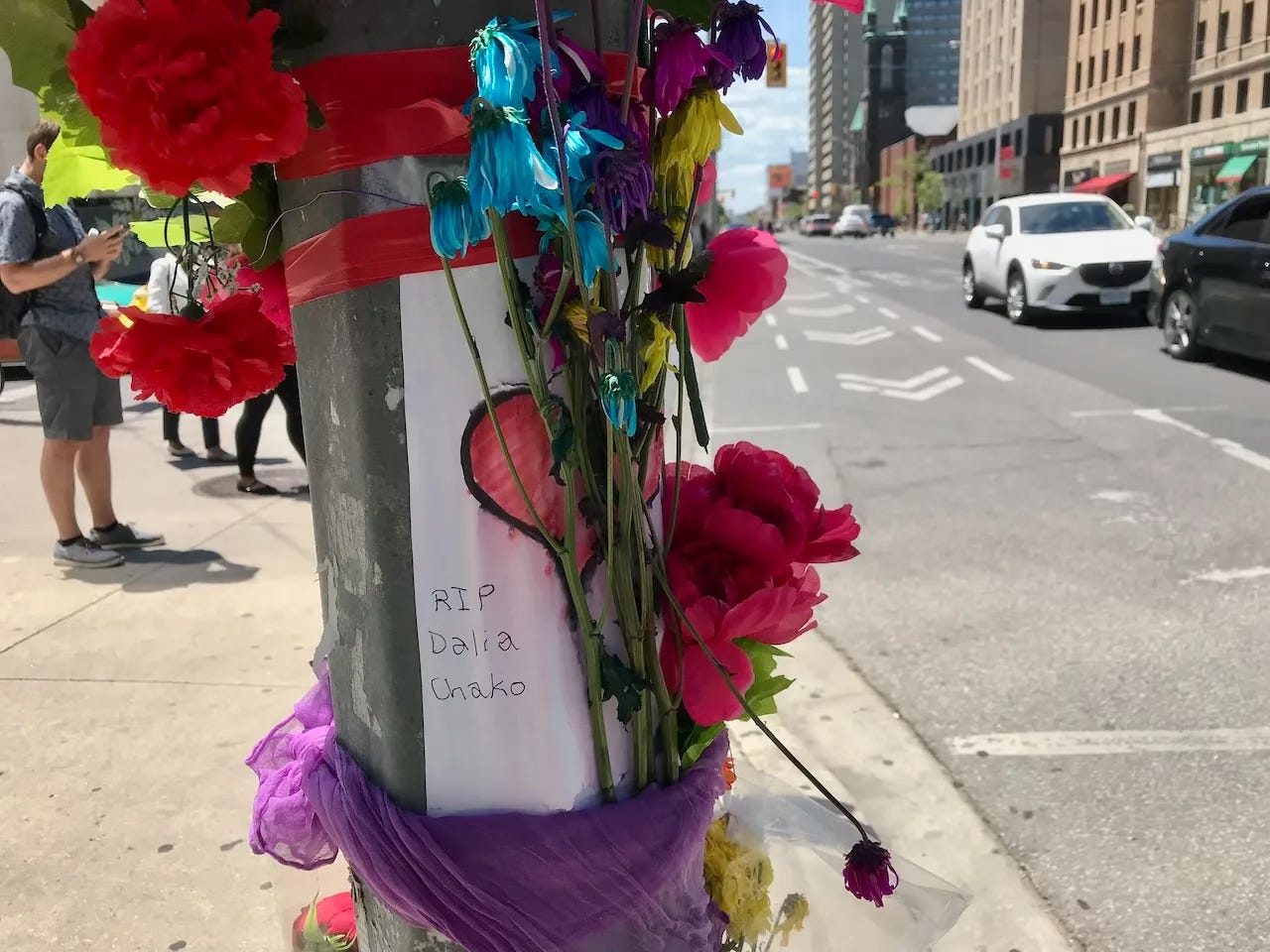
Last fall, the Premier of Ontario, Doug Ford, passed Bill 212- the “Reducing Gridlock, Saving You Time Act, 2024" which gave the Provincial Government the right to review every new bike lane proposal requiring a reduction in traffic lanes for cars, but also the power to remove existing bike lanes on major Toronto streets.

I complained at the time that this was ridiculously disproportionate in its effects; “The Minister of Transportation says he takes “a leap of faith that I’ll be able to get to the office on time." I take a leap of faith about whether my family will get to work alive.”
Cycle Toronto and Ecojustice took the Province to the Ontario Superior Court, claiming that the act violated cyclists’ rights under Section 7 of the Canadian Charter of Rights, which states:
Everyone has the right to life, liberty and security of the person and the right not to be deprived thereof except in accordance with the principles of fundamental justice.
Justice Schabas concluded that removing the bike lanes would significantly increase the likelihood of injuries and deaths. He called the law arbitrary and grossly disproportionate.
“In this case, the evidence is clear that restoring lanes of motor vehicle traffic by removing the bike lanes, or reconfiguring them so that they are no longer physically separated from cars, will lead to more accidents, injuries and deaths. The government has recognized this, adding the immunity provisions at the same time as the target bike lanes provision. People who cycle as their means of transportation are vulnerable, and more so when riding in mixed traffic. It is reasonable to conclude that people who cycle will be injured and killed when lanes for motor vehicles are installed and protected bike lanes are removed. That impact is grossly disproportionate to the asserted benefit, taken at face value, of saving some drivers of cars a few minutes of travel time.”
I was going to write more about this, but John Lorinc does such a terrific job of it in Spacing that I am just going to point everyone to Bike Lanes: 2 - Ford Nation: 0
Of course, Doug Ford says the province will appeal the decision, but Lorinc doesn’t think their prospects look good.
“An Ontario appeals court already rejected the government’s first attempt to quash Schabas’ injunction. And as Schabas himself points out, the Tories have, in effect, let all the air out of their rhetorical tires. After all, the evidence demonstrating the government’s flagrant disregard of the facts, as well as the mountain of documentation that puts the lie to virtually its entire legislative argument, means that any attempt to re-litigate this nonsense will invariably loop back to the formidable case assembled by Cycle Toronto, its expert witnesses, and its legal team.”
Alas, I am not so sure; we have seen this movie before. Under our constitution, the city is “a creature of the Province,” which has demonstrated that it can do pretty much whatever it wants. When Ford cut the size of the City Council in half in the middle of an election, the lower court said he couldn’t stomp all over the city like that, and the Appeals court said he could essentially do whatever he wanted. He has been the de facto mayor of the City ever since, making all the major land use and transportation decisions. I am not sure the court will care if he had a case, because he has the power.
Lorinc concludes, “Yesterday was a good day, one well worth celebrating.” It is, but this isn’t over yet.
Meanwhile, Andrew Miller, who describes himself as an “Urbanist, cyclist, and transport enthusiast. Author, speaker, consultant. Fellow, Roots of Progress Institute,” raises an interesting question on his Substack: Is this setting a terrible precedent where every NIMBY will now add charter challenges to their repertoire?
“Now every time a government wants to build something—a highway, a transit line, whatever—opponents can claim Charter violations. "This new subway will increase noise and that violates my security of the person!" "This highway will bring pollution that threatens my life!" We've just made building anything harder… The principle is established: infrastructure decisions can be litigated on human rights grounds. Every NIMBY lawyer in the country is updating their playbook as we speak.”
I agreed with the other party in this discussion over coffee, who noted that this case was particularly weak, and I would add, disproportionate and arbitrary.
“You think that'll stop anyone? The process is the punishment. Even if spurious Charter claims eventually fail, they'll tie up projects in court for years. We already have environmental assessments, heritage designations, local council vetoes... now add constitutional litigation to the mix. The whole YIMBY project just got harder.”
Hmmmm….
More background:

Special offer!
I do not want to put up a paywall on this site, but it provides a meaningful portion of my income. So here’s a limited-time offer: I will send a signed copy of the print edition of “Living the 1.5 Lifestyle” to anyone in the USA or Canada who signs up for a one-year subscription (C$50, cheap at about US$35 ).
Excellent post, excellent article by Lorinc, and a great decision by the Judge.
Re the speculation that from now on "every NIMBY will now add charter challenges to their repertoire": perhaps, but the Judge carefully argues that the problem is not just with the government taking an action that will increase the risk of death or injury to some people. The problem is increasing this risk without showing that the risk is offset by corresponding and proportionate benefits – it's the arbitrariness and disproportionality of the government's action that makes it a Charter violation.
Ford overplayed his hand....