

I received an email this morning from Nick McKeogh, CEO of the NLA (I think it's short for New London Architecture; it’s hard to pin down), regarding the One Built Environment Declaration, which calls on the British Government to recognize that “everyone who plans, designs, funds, builds, manages and renews the UK's built environment” is really part of one industry.
“Housing, planning, transport, infrastructure, energy and regeneration aren't separate problems — they're one industry, hiding in plain sight. Right now, government sees us in fragments, split across departments and funding streams. That fragmentation costs growth, jobs and investment every single month.”
It’s based on a 2025 report, The Built Environment Sector, and discusses the professions in the UK, but the concept is relevant everywhere.
“The UK’s built environment is made up of the human-made spaces and infrastructure within which we all live our lives. This includes the homes we live in, the roads we move on, the public spaces we gather in and the shops, hospitals and schools we rely on. It houses the offices, data centres, logistics hubs and research laboratories that power the modern economy. The built environment includes not just buildings and what we see at ground level but also the infrastructure that services them, much of which runs through intricate, largely unseen networks below and above us.”

This is an issue that I have complained about for years- the separation of everything into separate silos. I was originally inspired by Jarrett Walker’s tweet (one of the three most influential tweets I ever saw back when you saw such things on Twitter) that crystallized the idea that you couldn’t talk about buildings separately from transportation or, for that matter, sewers and electric lines; we are all talking about the same thing.
I concluded my book, Living the 1.5 Degree Lifestyle, paraphrasing Walker:
"How we live and how we get around are not two separate issues; they are two sides of the same coin, the same thing in different languages. It’s much easier to live a low-carbon life if you live in a place designed before the car took over, be it a small town or an older city. But for the people who don’t do that, the problems are immense."

I was primarily concerned with carbon emissions, and thought they should all be considered together as coming from one source- why separate transport, building, or industry when we are making steel and concrete to make roads and cars to drive between buildings? It all connects. The NLA takes the relationships much further:
“Our lives are deeply interwoven with the built environment in countless ways. People in the UK spend between 80-90% of their time indoors, in homes, schools, workplaces, other public spaces and on transport. The quality of these spaces and places matters. Availability of public transit, social infrastructure, or green space can impact health, wellbeing and economic prospects. Pensions are often invested in the built environment, meaning the financial performance of buildings and infrastructure impacts a pensioner’s ability to enjoy their retirement. The built environment shapes access to opportunity, with the location of affordable housing, schools, and jobs either reinforcing or reducing social inequality. It reflects cultural values, influencing whether people feel a sense of belonging or exclusion. And it will play a pivotal role in how well the world will adapt to a changing climate.”
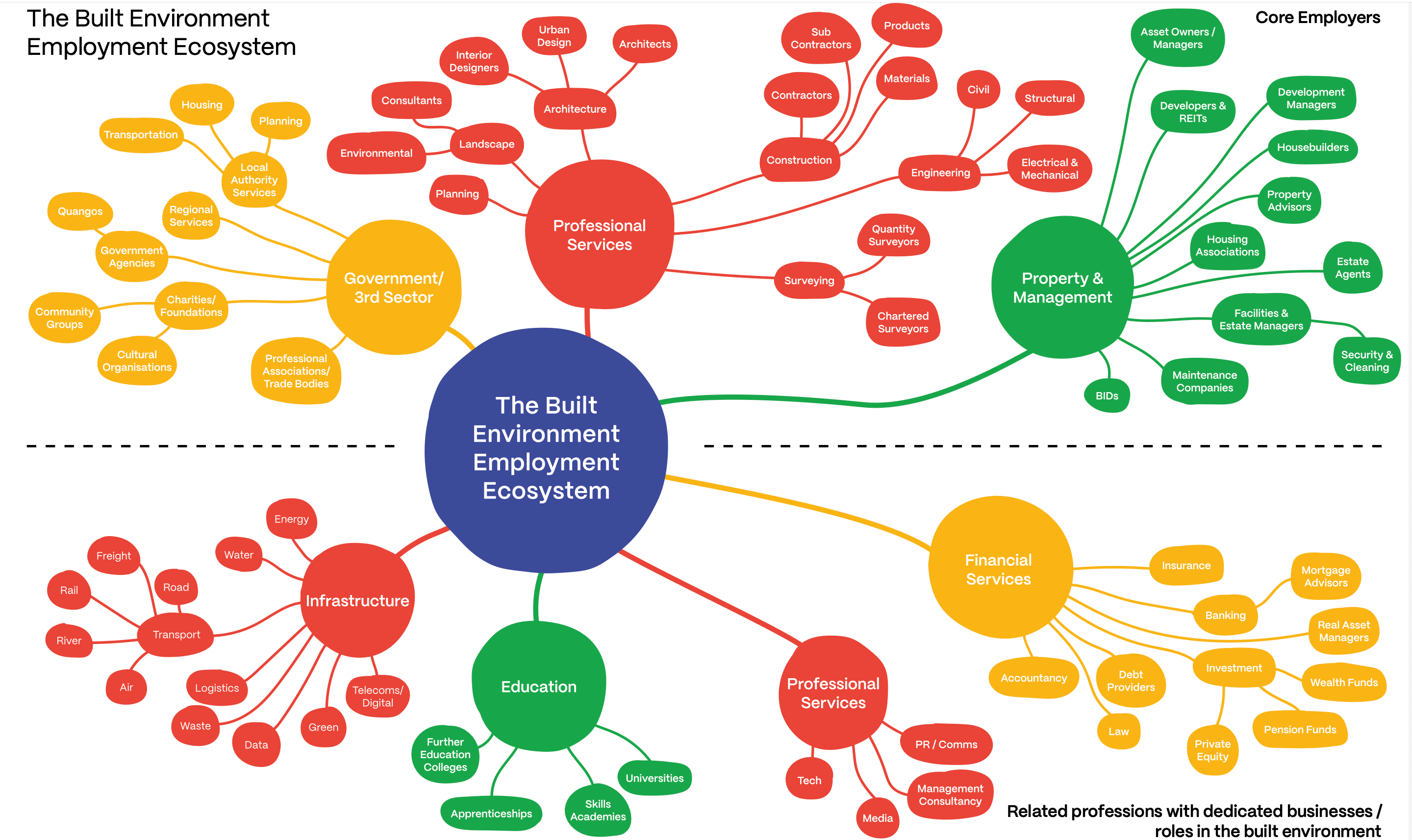
When I started in real estate development in the 90’s during a recession, I asked another successful developer how he spent his days. He told me, “In the morning, I fight with the trades. In the afternoon, I fight with the banks. In the evening, I fight with my purchasers.” This is after he has finished fighting with City Hall and paying for infrastructure and marketing. Everything is connected; everyone in every bubble in the built environment ecosystem.
So many bubbles. Even pensions; I hadn’t thought of this, but where I live, the Canada Pension Plan owns the toll Highway 407 that everybody hates, and the Ontario Teachers Pension Plan owns Cadillac Fairview, the biggest and best real estate developer in the country. It is all more connected than I thought.
Yet government policy is all over the map. Different ministries, from finance to housing to education, are going in different directions. For example, in Canada, one department might support renovation and restoration of existing buildings, while another cuts education programs for training workers in heritage trades. Hospitals get moved to suburbs without transit. Nobody thinks about carbon emissions. The NLA writes:
“While those working within the built environment sector understand its immense value, it lacks a clear and cohesive definition. It can at times feel fragmented: in terms of how public investment and policy are conceived and implemented, in how professionals are educated, accredited, and represented and, perhaps most subtly, even in the professional identities many in the sector have constructed for themselves.”
The declaration’s final point is a call for government and industry to work together:
Build a long term strategy with us. Co-develop a regionally led Built Environment Industrial and Investment Strategy — one that lets places use devolved taxes to raise capital, backs national supply chains, creates skilled jobs, and grows exports.

The NLA is not the first to note that we are not separate silos but part of a bigger Built Environment Industry. While there are Architects Declare and Engineers Declare groups,
“BUILT ENVIRONMENT DECLARES is a global petition uniting all strands of construction and the built environment. It is both a public declaration of our planet’s environmental crises and a commitment to take positive action in response to climate breakdown and biodiversity collapse.”
Once again, everything connects.
“For everyone working in construction and the built environment, meeting the needs of our societies without breaching the earth’s ecological boundaries will demand a paradigm shift in our behaviour. If we are to reduce and eventually reverse the environmental damage we are causing, we will need to re-imagine our buildings, cities and infrastructures as indivisible components of a larger, constantly regenerating and self-sustaining system.”
When we are fragmented and do not recognize the larger connected systems, nobody is talking about decisions, from expanding airports to ripping out bike lanes, in terms of their larger impacts and their longer-term implications. They are building highways instead of imagining a world with fewer cars.
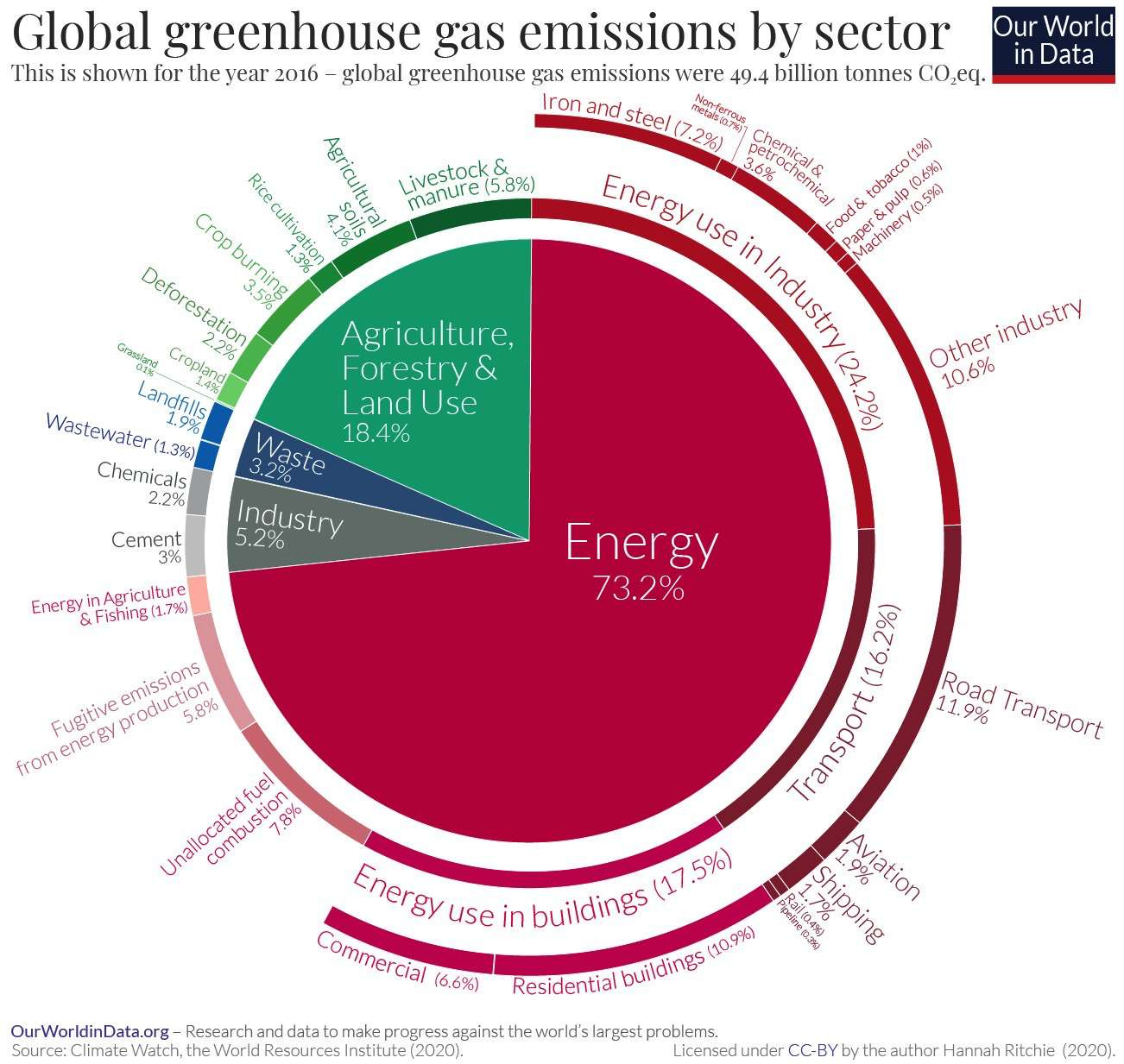
When I looked at this question a few years ago, I complained about the ridiculous divisions of emission sources in pie charts.
“Instead of looking at every sector on its own, if you take a consumption-based view of where all this stuff goes into, and where all the carbon emissions come from, the vast majority of emissions are coming from operating our buildings, driving our cars between our buildings, or making the materials to build our buildings and our cars. You almost end up with agriculture and aviation as being the two largest categories that don't fit into Built Environment Emissions. By this standard, Built Environment Emissions might be as high as 75%.”
The NLA report goes much further than anything I have seen to demonstrate how economically dominant the Built Environment Sector is. Others and I have tried to point out how it also dominates emissions. It’s time we all recognized that unless we all work together, all those red and green and gold and blue bubbles on that Built Environment Employment Ecosystem chart, we are never going to solve our economic or environmental problems in time.
American schools began teaching the concept of integrated planning in the late sixties or earlier seventies. In 1972, the board game CLUG (Community Land Use Game) was used in schools and colleges to teach aspiring government officials the same basic concepts you propose. I remember it well - planning over pizza. When I was appointed to the local Planning Commission a decade later, it was disappointing to realized the group was not much more than a zoning and variance board. And when our sub-committee insisted on beginning a state-mandated general plan review, we got push-back; boy, did we. The Chair of the Commission, the Mayor and City Council got together and decided we had a quorum problem (we did not - public record). With that lie, they cut the membership of the commission from nine citizens to five, leaving only the non-planner types in place to give them their concessions in the form of variances and conditional permits. That was more than thirty years ago. The city is a mess.
Planning to not plan is an option behind the scenes, and as long as money remains in politics it will play it's role. Hopefully, some will find ways to profit from your ideas; maybe they will be more likely to come to fruition. Thanks again for your writing.
Just a short note to highlight a principled stand of one man named Agee. He was and maybe still is a designer of airports. He was invited to make a design for the them about to be built Sacramento International Airport. At the time the site was surrounded by empty space.
When he discovered there was no plan to connect it to the city with the new light rail system being built he withdrew his participation. That space is now filled with an Amazon campus and wall to wall developments. No light rail. Just asphyxiating traffic.