
Last year, everyone was talking about Abundance, based on the thesis that we can have “the future we want” with affordable housing, clean air and water, supersonic weekends in London, all powered by geothermal, nuclear and renewables, with AI and other technologies lifting billions out of poverty, if we just let builders build and inventors invent.
In the meantime, we can keep burning fossil fuels because soon we will be able to suck the carbon dioxide out of the air.
This is the abundist dream fantasy Mark Carney is selling Canadians with the Pathways project, and what many companies are trying to sell with direct air capture (DAC) of carbon dioxide. There are lots of promises and lots of interesting research, but how much of it is realistic, affordable, and achievable in any reasonable timeframe? Can they really build and invent us out of this problem?

Here is an example. One intractable problem is making cement, one of Vaclav Smil’s four pillars of civilisation. It alone accounts for 7% of emissions. About half of the emissions come from the "chemical fact of life"—the CO2 emitted in calcination or turning calcium carbonate into calcium oxide, a key ingredient in cement. The other half comes from burning coal or fossil gas to drive the calcination.
Recently, researchers at ETHzürich wrote up a new study that “shows how cement production could in future be used to remove CO₂ from the atmosphere – based on a technology utilising lime.” Any proposal based on sucking CO2 from the atmosphere makes me sceptical, but what’s the plan here?
“For the study, the researchers collaborated with the US company Heirloom Carbon Technologies. The company is one of the world’s leading developers of DAC based on calcium looping – a process that utilises a chemical cycle involving various calcium compounds.”
In this system, limestone (calcium carbonate) goes into an electric calciner and decomposes into calcium oxide (quicklime) and carbon dioxide at 894°C. The CO2 from the calcination process is usually mixed up with the CO2 from the coal or gas used to heat it, but here we are using a LOT of renewable electricity, and get a clean stream of CO2 from the calcination.

Heirloom, as I explained in my earlier post, normally takes its own calcium carbonate, cooks it into calcium oxide, grinds it into powder, adds water to turn it into Ca(OH)2 slaked lime, spreads it out on cookie sheets, and absorbs CO2 out of the atmosphere as it recarbonates it back into calcium carbonate in a closed loop. They reheat it, capture the CO2 and stick it away somewhere, and then do it again. I tried to explain it here:

It is a modern riff on the classic lime cycle known for thousands of years.
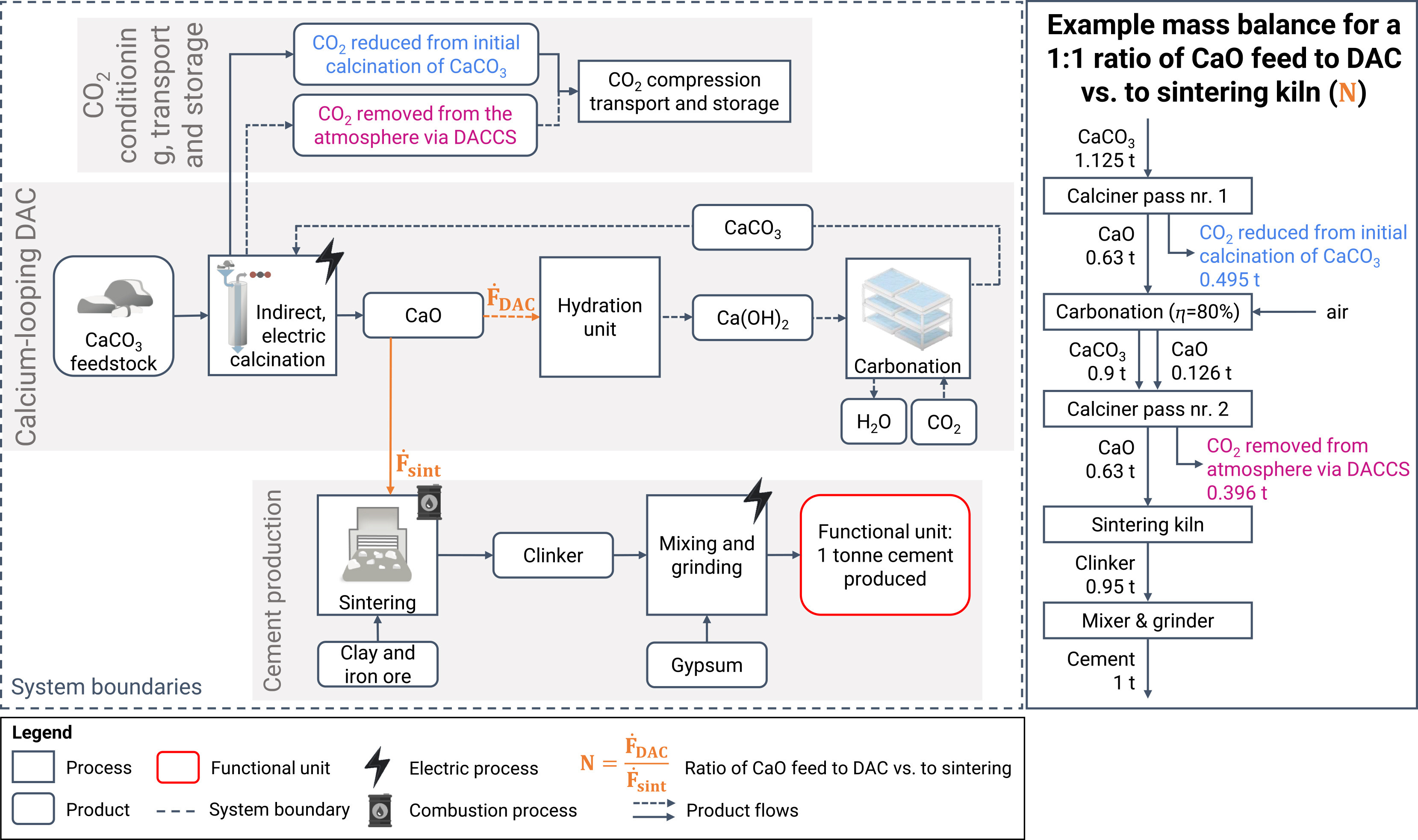
The trick here is that they take the quicklime from the cement kiln’s calciner, send it on a detour to Heirloom, put it on the cookie sheets, and then, a few days later, send it back and run it through the calciner again. It is a bigger, more complicated loop, and it is no longer closed, since after a few round trips it is turned into cement and fresh limestone is needed.
Electrifying the calciner alone reduces emissions by 60%. Each run through the Heirloom DAC sucks out more CO2- do it often enough and you can get to zero emissions.
“We were able to show that the technology has a net-negative carbon footprint; in other words, commercial calcium looping DAC plants with CO₂ storage remove more CO₂ than they generate over their entire lifecycle,” says [researcher] Bolongaro.
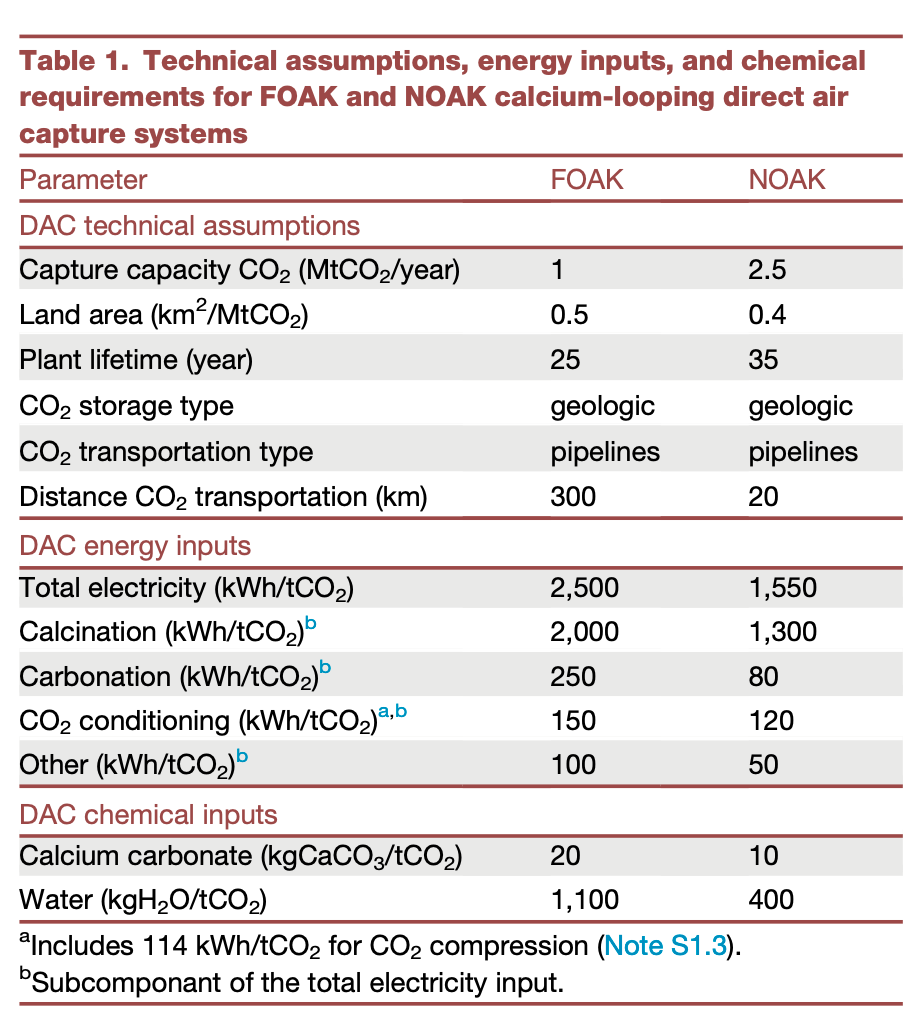
The problem is the cost in electricity- 1550 to 2500 kWh per tonne of CO2 captured, or 614 to 990 kWh per tonne of cement. Mix it up into concrete and you are sitting at close to a thousand kWh per cubic meter.
Multiply all of this by the amount of concrete that is currently used every year, and the amount of renewable electricity available, and you can only conclude that we don’t have the electricity, we don’t have the money, and we don’t have the time. Even the researchers get this:
“The key calculations for the study are based on future scenarios up to the year 2050 and assume significant progress in the decarbonisation of the electricity supply. Furthermore, some of the plant components, in particular indirectly heated electric calcining kilns, are not yet in large-scale industrial use. It therefore remains to be seen whether the system can be operated economically.”
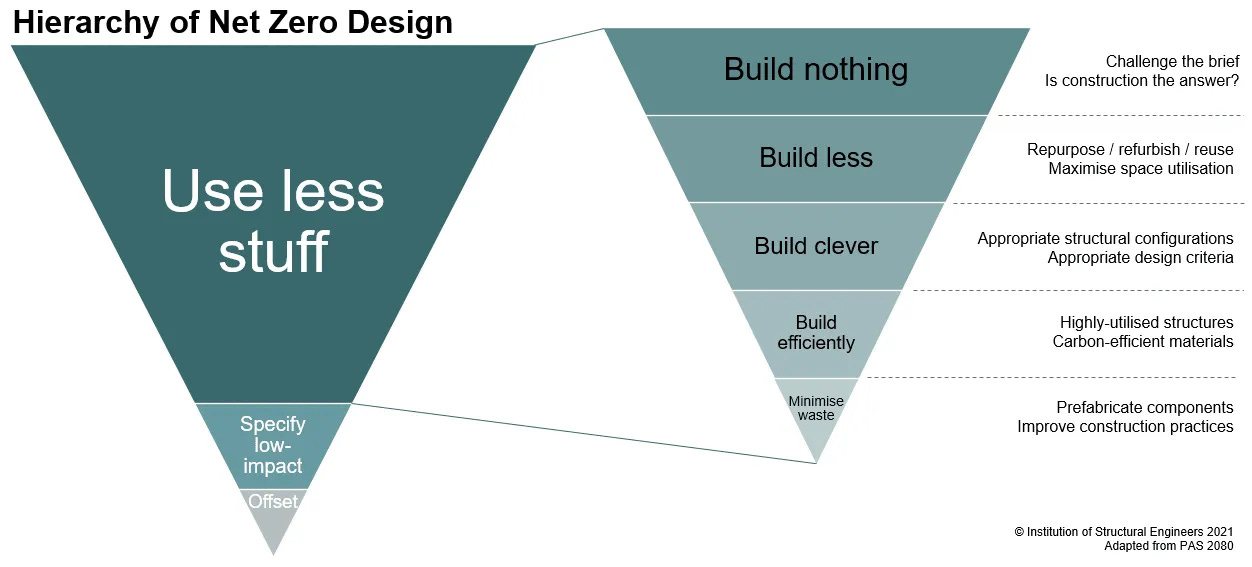
This is why, whenever I write about concrete, I conclude that the best way to deal with the problem is to use less of it. In many cases, we can substitute lower-carbon materials such as mass timber or stone. Will Arnold points to research showing that good design and smart span selection can reduce the amount of concrete in a floor slab by 30%. Recent research by Shoshana Saxe and Avery Hoffer at the University of Toronto has shown much the same thing.
As clever as those ETHzürich kids are, coming up with complex, expensive systems that will take decades to implement is not going to save us. If anything, they divert our attention from tools and options we already have. And it is why I always come back to Will Arnold’s three words: Use Less Stuff.
ETHzürich press release here.
Full article: Life cycle assessment of solid calcium-looping direct air capture and its synergistic dual use for net-negative cement
Too technical for my understanding (no, I'm not looking for an explanation). I lean to the Use Less Stuff / Keep it Simple brigade.
Excellent quick review of the issue with concrete. Use less! Should not be hard to understand.